The Real Downsides of Owning an Older Hybrid in Arizona
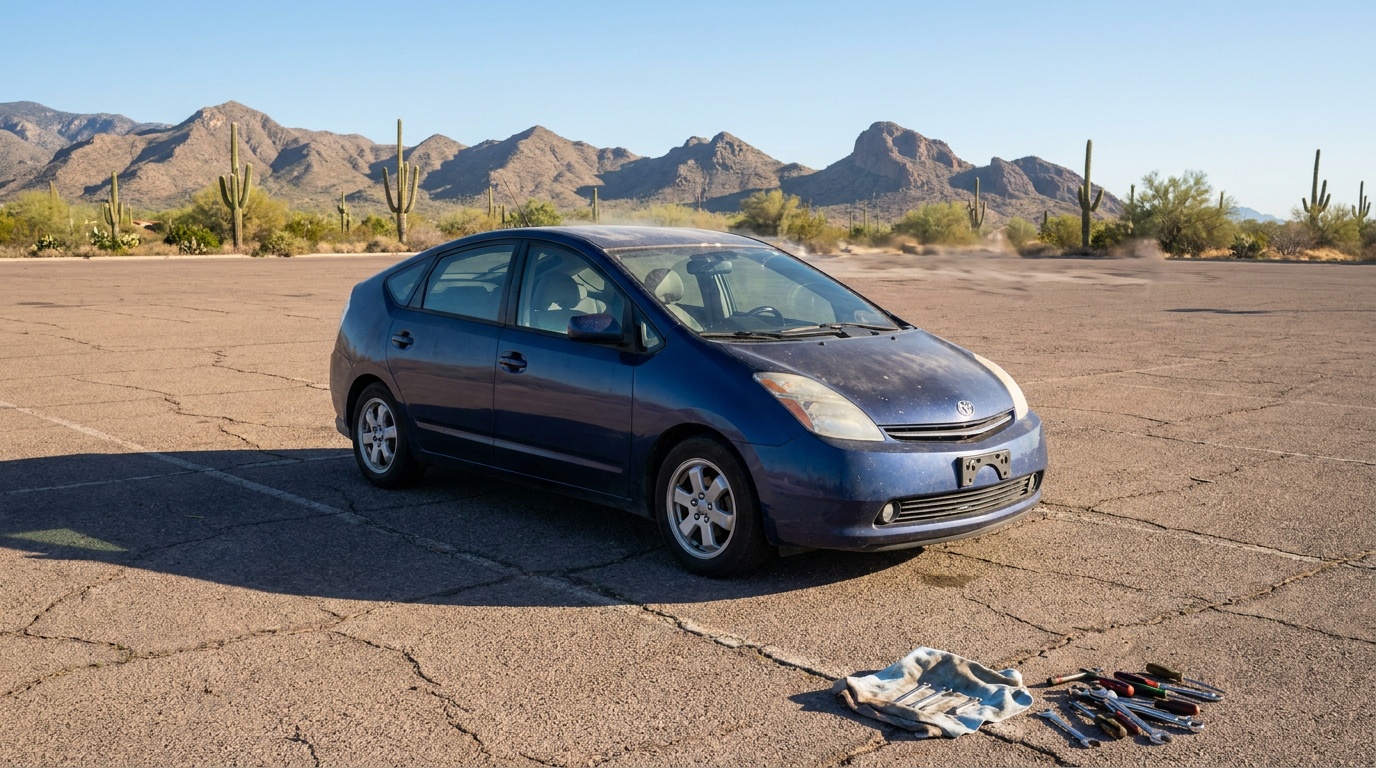
Heat-aged packs, a cooling intake nobody checks, and resale fear are the real downsides of an older hybrid in Arizona — and what balances them.
An older hybrid in Arizona has four genuine downsides: a traction pack that ages faster in 110°F summers than the identical pack does in a mild climate, a battery cooling system that depends on cabin air staying clear, a repair a lot of general shops will decline, and a used market that discounts hard on battery fear. None of those are reasons to avoid a hybrid — but they are real, and you should know them before you buy or before you decide what to do with the one in your driveway.
Here is the honest version of both sides.
Does Arizona heat actually shorten hybrid battery life?
Yes, and it is the single largest factor in how these packs age. The nickel-metal-hydride modules in a Prius, Camry Hybrid, Highlander Hybrid or CT 200h lose capacity faster when they spend their life hot. Heat accelerates self-discharge, and uneven self-discharge is what pushes individual modules out of balance with the rest of the pack.
The number that matters is not the outside air temperature. It is the temperature inside a closed car parked on asphalt in July, which climbs far above ambient and stays there for hours while the pack sits with no airflow over it. A hybrid in Phoenix, Mesa or Surprise accumulates far more of those hours than one in a coastal city.
The practical result: Arizona owners tend to see the first symptoms earlier in the car's life than the national talking points suggest. Falling fuel economy, a state-of-charge bar that swings from two bars to full and back in a few miles, the engine running more at low speed, and eventually a red triangle with P0A80 — Replace Hybrid Battery Pack or a block-weak code in the P3011–P3024 range.
What's the deal with the battery cooling fan?
Most Toyota and Lexus hybrids cool the traction pack with cabin air, pulled through a small intake vent — usually low on the side panel behind or under the rear seat. That design works well. It also means the pack's only cooling supply is whatever the interior of your car is doing.
Two things go wrong in Arizona. Dust and pet hair restrict the intake, and owners block the vent with cargo, a car seat base, or a folded seat back. When airflow drops, the hottest modules in the pack run hotter still, and those are the ones that fail first.
The cheap habit that helps: keep that vent clear, run the A/C rather than the windows on long summer drives, and park in shade or a garage when you have the option. Shade is not a small thing here. It is probably the highest-value free maintenance any Arizona hybrid owner can do.
Why won't a regular shop work on it?
The traction pack runs at high voltage — roughly 200 to 650 volts depending on the model. That is not a job a general independent shop takes on casually, and many won't. So the older-hybrid owner often finds themselves with exactly two answers: a dealer quote for a new pack, or a shrug.
That narrowing of options is a real downside. It is also the part most people overestimate, because they assume "specialist repair" means "open-ended bill." It doesn't. Hybrid battery work is a known job with known parts and a fixed price. Here is what it actually costs, installed at our shop, for a Prius or CT 200h:
| Option | Price installed | Warranty | |---|---|---| | New OEM battery | $3,500 | 5 years | | New aftermarket battery | $2,100 | 4 years | | Rebuilt — Extended | $1,400 | 2 years | | Rebuilt — Standard | $1,000 | 1 year | | Rebuilt — Essential | $600 | 6 months |
Those are set prices for Prius and CT 200h; other models vary on install labour. Most installs take about 30 minutes. If you want us to come to you instead, mobile install is a $250 add-on. New nickel-plated bus bars with stainless nuts are $99 if you want the fresh hardware with the pack. Full detail is on the pricing page, and the warranty terms explain what each pack's coverage includes — labour for the full term, not prorated, and it stays with the car if you sell it.
Does an older hybrid hurt resale value?
In a used market, yes — buyers discount hybrids with unknown pack history, and they discount them by more than the repair usually costs. A ten-year-old Prius with no battery records makes a private buyer nervous in a way a ten-year-old Corolla does not.
The flip side is that a documented pack replacement with transferable coverage removes that exact objection. Because coverage stays with the vehicle, a buyer is getting a car with a known battery and remaining warranty, which is a stronger position than most used cars are in.
What's genuinely good about keeping the older hybrid?
The fuel economy is real, not a brochure figure. In stop-and-go Valley traffic — Loop 101 at 5pm, surface streets across Chandler and Gilbert — a hybrid drivetrain is doing its best work, because that is where regenerative braking and electric creep pay off.
The rest of the car tends to be long-lived. Toyota and Lexus hybrid transaxles have no conventional clutch pack or torque converter, the brakes last unusually long because regen does much of the slowing, and the engine spends a lot of its life off. The maintenance profile of these cars is not worse than a conventional sedan. It is different, and mostly lighter.
One more thing worth knowing before you panic-diagnose: the 12V battery, which is separate from the traction pack, causes a startling number of hybrid scares. A weak 12V produces a dash full of warning lights, a no-start, and symptoms that look exactly like a dying pack. A 12V replacement runs $100 to $400 — so it is always worth ruling out before assuming the worst. That is one of the first things checked in a 12V versus hybrid battery diagnostic.
If you want to see how a specific model tends to hold up, the vehicle pages break it down by platform, from the third-generation Prius to the RAV4 and Highlander Hybrid.
The diagnostic is free, and we come to you anywhere across the Valley. If your fuel economy has slipped or a warning light is on, book a free mobile diagnostic or call 623-323-0737 and get a real answer before you make a decision about the car.