What Happens During a Hybrid Battery Diagnostic? A Step-by-Step Walkthrough
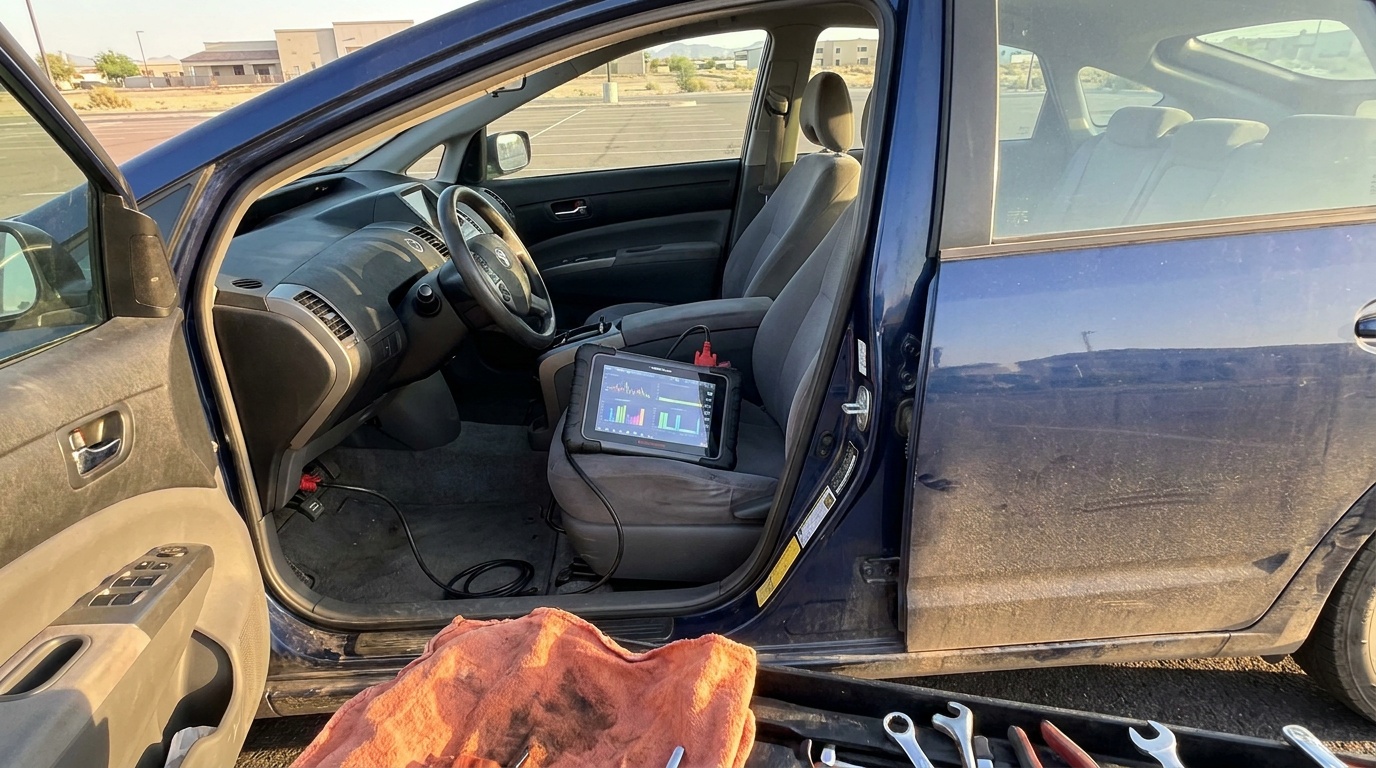
A real hybrid battery diagnostic reads all 14 block voltages under load, checks cooling and the 12V. Here's every step and what the numbers mean.
A proper hybrid battery diagnostic measures the voltage of every block in the pack — 14 of them in a Prius — at rest and under load, then compares the spread between the strongest and the weakest. Everything else in the test exists to answer one question: is the pack itself failing, or is something around it making the pack look bad?
Our hybrid battery diagnostic is free, and we do it at your home or workplace anywhere we cover in Arizona. Here is what actually happens, in order.
Step 1: What are the symptoms, and when do they happen?
Before anything is plugged in, the symptom pattern narrows the field. A car that throws a red triangle only after sitting overnight in July behaves differently from one that loses power climbing a grade on the 17.
We ask when it started, whether the state-of-charge bars swing fast between two and eight, whether the engine now runs constantly at stoplights, and whether the 12V has been replaced recently. Cars that have sat for weeks in Arizona summer heat tell a different story than daily drivers.
Step 2: Full scan, not just engine codes
A generic code reader plugged into the OBD-II port often shows nothing on a hybrid, because the important codes live in the hybrid vehicle control ECU and the battery ECU — not the engine module. We scan every module and pull stored, pending, and history codes.
The ones that matter most:
| Code | What it means | What it usually is | |---|---|---| | P0A80 | Replace hybrid battery pack | One or more blocks out of range; battery ECU has given up on balancing | | P0A7F | Hybrid battery pack deterioration | Capacity loss across the pack, often before P0A80 sets | | P3011–P3024 | Block 1 through 14 becomes weak | Names the exact weak block by number | | P0AA6 | HV isolation fault | Leakage to chassis — pack, inverter, A/C compressor, or a coolant intrusion | | P0A94 | DC/DC converter performance | Not the traction pack — the converter that charges your 12V |
That last row is why a scan comes before conclusions. Several codes that feel like a dying pack are not one.
Step 3: Block voltages at rest
With the car off and the pack at rest, we read each block. On a Toyota or Lexus NiMH pack, each block is two 7.2V modules in series, so a healthy block sits around 15.2 to 16.2 volts depending on state of charge.
What matters is not the absolute number but the delta — the gap between the highest and lowest block. A pack where every block lands within about 0.2V of the others is balanced. A pack with one block sitting 0.8V below the rest has a problem that will only get worse, because the battery ECU keeps charging and discharging the whole string to satisfy that weak block.
Step 4: Load testing — the step that separates a good pack from a tired one
Resting voltage lies. A worn module can hold a normal-looking resting voltage and then collapse the moment current flows through it. This is the single most common reason an owner gets told "your battery tested fine" and then throws a code two weeks later.
So we watch block voltages live while the pack is worked — under regenerative braking charge and under discharge. A healthy block barely moves relative to its neighbours. A failing block sags hard under discharge and spikes high under charge, because its internal resistance has climbed.
On the report you will see the spread under load, not just at rest. A delta above roughly 1.0V under load points at specific modules, and we can name which ones.
Step 5: Cooling system inspection — and why Arizona makes this step matter more
NiMH packs are air-cooled. In most Toyota and Lexus hybrids, cabin air is pulled through a vent — usually behind the rear seat or in the side trim panel — across the modules and out by a fan.
In Arizona, two things attack that path. Dust, especially after monsoon season, packs the intake screen and the fan squirrel cage solid. And ambient heat means the pack is already starting from a higher baseline: a car parked outside in Phoenix in July can have an interior well above 140°F, and the pack sits in that air. Heat accelerates the chemical aging that creates block imbalance in the first place. A pack with a clogged cooling path in Arizona ages faster than the same pack in a mild climate, and that is the main reason hybrid packs here tend to fail years earlier than the national numbers suggest.
So we inspect the intake, the ducting, the fan operation, and look for any coolant or debris intrusion around the pack.
Step 6: 12V verification
A weak 12V battery causes symptoms that look exactly like a dying hybrid pack — dash lit up with multiple warnings, the car refusing to enter Ready, the red triangle, strange codes across several modules. The 12V in a hybrid is a small auxiliary battery, and Arizona heat kills them fast.
We load test the 12V and check charging voltage from the DC/DC converter before signing off on any hybrid pack conclusion. This is a real and frequent outcome — see 12V versus hybrid battery testing. A 12V replacement runs $100 to $400 depending on the vehicle.
What does the report actually show you?
You get the block-by-block numbers, resting and under load, the delta, any stored codes with the block they point to, and the cooling and 12V results. If the pack is the problem, you will know which blocks and how far out they are. If it isn't, you'll know that too.
From there the options are straightforward. These are set installed prices for Prius and CT200h; other models vary on install labour.
| Option | Price installed at our shop | Warranty | |---|---|---| | New OEM battery | $3,500 | 5 years | | New aftermarket battery | $2,100 | 4 years | | Rebuilt — Extended | $1,400 | 2 years | | Rebuilt — Standard | $1,000 | 1 year | | Rebuilt — Essential | $600 | 6 months |
Mobile install at your location is a $250 add-on. New nickel-plated bus bars with stainless nuts are $99 if you want them. Most installs take about 30 minutes. Full details are on the pricing page and the hybrid battery replacement page.
If your pack still has usable life but is starting to drift, reconditioning and annual service are the other path, and the diagnostic numbers tell us which of those makes sense.
The diagnostic costs nothing and we come to you across the Valley. Call 623-323-0737 or book a free mobile diagnostic and you'll have the block voltages in hand before you decide anything.