Replacing a Hybrid Battery Before Summer vs. After: Does Timing Matter?
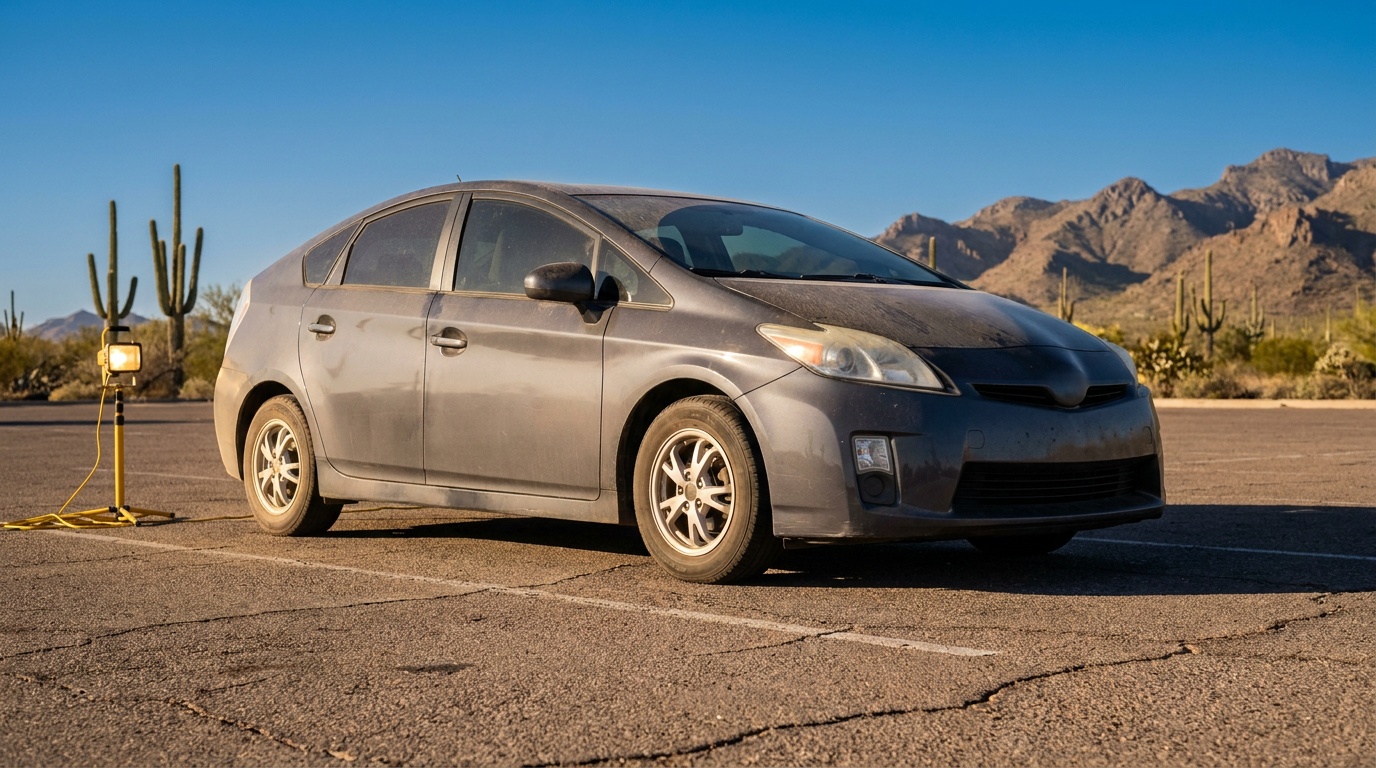
A pack that limps through a 70°F February often quits in a 110°F July. Here's how Arizona heat exposes weak blocks — and how to decide from data, not dread.
Timing matters, and the gap is usually 8 to 12 weeks: a marginal pack that behaves through a 70°F February often fails outright once daytime highs hit 105–115°F. That isn't bad luck. Heat both speeds up the chemical ageing of a nickel-metal-hydride pack and strips away the margin that mild weather was quietly covering for.
That matters most for one specific person: the owner sitting on a borderline diagnostic result in March, trying to decide whether to spend money now or wait and see. The honest answer is that you should get measured before summer and then decide from the numbers — not spend early for the sake of it.
Why do hybrid batteries fail in summer and not winter?
A hybrid pack is a series string of modules or blocks. The car doesn't care about the average — it cares about the weakest link. When one block's internal resistance climbs, it heats faster than its neighbours, sags harder under load, and recovers slower on regen.
In winter, that weak block still sags, but the whole pack is operating with more thermal headroom. The cooling fan keeps up easily. Voltage spread between blocks stays inside what the battery ECU tolerates.
In July, three things stack up at once:
- Ambient air is the coolant. Toyota and Lexus hybrids cool the pack with cabin air. If the cabin is 95°F because you just got in, the pack is being cooled by 95°F air. A parked car in Phoenix can sit well above 150°F inside before you even start it.
- Fan duty goes to the top of its range and stays there. A fan running at maximum has nothing left to give when you hit a grade or a long climb. Anything restricting the intake vent — cargo pressed against it, pet hair, a filled trunk — costs you cooling exactly when you need it.
- Weak blocks get hotter than strong ones. Heat raises resistance, higher resistance makes more heat. That loop runs faster in summer, which is why a block that was "a bit low" in March can be a hard fault by June.
So summer doesn't create the problem. It reveals it, and then accelerates it.
What does a borderline March result actually mean?
Borderline means measurable weakness that hasn't yet tripped a code. You might see block voltages spreading apart under load, one or two blocks recovering noticeably slower, or mileage that's drifted down 8–10 MPG from what the car used to do. The dash may still be clean.
Here's how we'd read those states against an Arizona summer:
| What the diagnostic shows | What summer typically does to it | Sensible action in March | |---|---|---| | All blocks tight, no spread, normal recovery | Nothing dramatic. Normal seasonal ageing. | Re-measure next spring. No spend. | | Mild spread, MPG down slightly, no codes | Spread usually widens. Some cars hold, some don't. | Measure now, re-measure in 60–90 days. Decide on the trend. | | Wide spread, one slow block, still no light | High chance of a code or a hard failure in peak heat. | Plan the work before July. Waiting mostly buys a roadside failure. | | Stored P3011–P3024 "battery block becomes weak" | The named block rarely recovers. It gets worse. | Replace or rebuild now. | | Active P0A80 | Already failed. Heat is irrelevant to the decision. | Replace. |
The useful line isn't "before or after summer." It's whether you have data or a guess.
Does replacing before summer make the new pack last longer?
Marginally, and not enough to justify spending money you don't need to spend. A new pack installed in April versus one installed in September will see roughly the same number of hot months over its life. There is no meaningful head start.
What replacing before summer genuinely buys you is different:
- You choose when and where the car is down instead of the car choosing for you.
- You avoid a failure on a 115°F afternoon with a full car, which is the scenario nobody wants.
- You avoid the secondary damage a struggling pack can cause when the engine ends up carrying loads it wasn't meant to carry alone.
That's a risk argument, not a longevity argument. We'd rather tell you the difference than sell you the wrong reason.
Is reconditioning worth doing before a hot season?
Sometimes, and it depends entirely on what the measurements show. If the pack is broadly healthy with a couple of lagging blocks, reconditioning and balancing can pull the spread back in and give the cooling system less thermal unevenness to fight. If several blocks are worn, reconditioning is delaying the inevitable and you'll be paying twice.
For packs that are still in good shape, annual hybrid battery service is the version of this that actually makes sense in Arizona — measure once a year, catch the spread while it's small, and go into summer knowing where you stand. Spring is the natural time for it.
What does it cost either way?
These are set installed prices for the Prius and CT 200h, installed at our shop. Other models vary on install labour.
| Pack | Price (installed at our shop) | Warranty | |---|---|---| | New OEM | $3,500 | 5 years | | New aftermarket | $2,100 | 4 years | | Rebuilt — Extended | $1,400 | 2 years | | Rebuilt — Standard | $1,000 | 1 year | | Rebuilt — Essential | $600 | 6 months |
Mobile install at your home or workplace is a $250 add-on. New nickel-plated bus bars with stainless nuts are $99. Most installs take about 30 minutes. Full detail is on the pricing page.
On warranty, coverage runs from 6 months on the Essential rebuild to 5 years on new OEM, labour included for the full term, not prorated, and it stays with the car if you sell it. What to ask about warranty lays that out.
The straight recommendation
Get a hybrid battery diagnostic in spring. If the numbers are clean, do nothing and re-check next year. If the numbers are ugly, deal with it before the heat does it for you. If the numbers are in between, measure again in two months and let the trend decide.
The diagnostic is free and we come to you anywhere across the Valley. Book a free mobile diagnostic or call 623-323-0737, and you'll go into summer with a number instead of a worry.