Hyundai Sonata Hybrid Won't Start but the Dash Lights Up
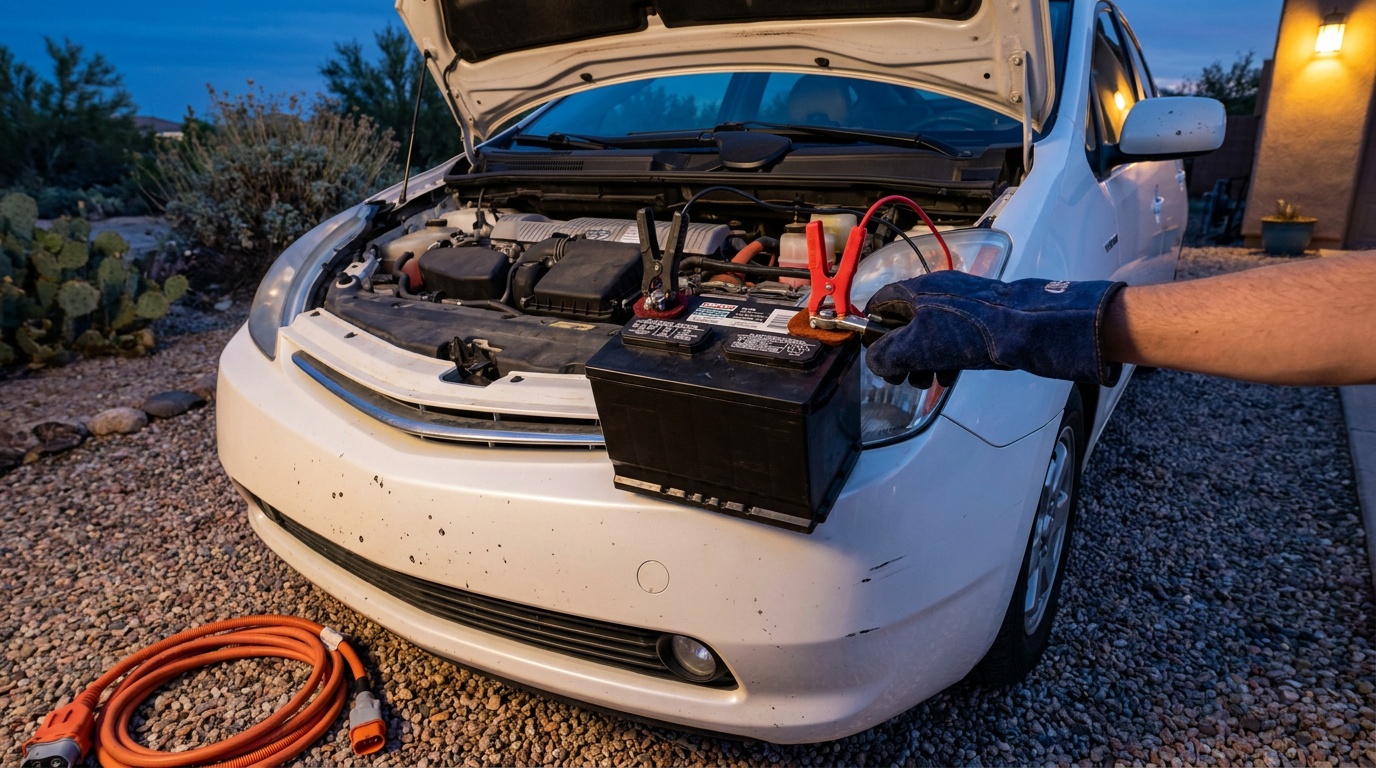
Dash lights on, no READY? On a Sonata Hybrid there are 3 likely causes. How to tell a weak 12V from a disabled hybrid system before you pay for a tow.
If your Hyundai Sonata Hybrid lights up the dash but never reaches READY, there are three realistic causes: a weak 12V auxiliary battery, a hybrid system that has shut itself down on a fault, or a high-voltage pack that can no longer support a start. On 2011–2015 Sonata and Optima Hybrids, a fourth possibility exists that most owners have never heard of — the 12V reset switch in the trunk.
Dash illumination alone does not mean your 12V is healthy. The instrument cluster wakes up on very little current. The hybrid control modules, the high-voltage contactors and the relays that close the main battery circuit need considerably more, and they are the first things to fail when 12V voltage sags.
What does "dash lights but no READY" actually mean?
A Sonata Hybrid doesn't crank in the conventional sense. Press the start button and the car runs a boot sequence: the 12V system wakes the computers, the computers check the high-voltage pack and the isolation circuit, then the main relays close and the green READY indicator appears. The gas engine may not even turn over at that moment.
So the failure point is whichever step it stopped on.
| Symptom | Most likely cause | What you'll usually also see | |---|---|---| | Dash lights, then dim or flicker on press; clicking from the rear | Weak or failed 12V auxiliary battery | Doors unlock slowly, radio resets, everything feels tired | | Dash lights normally, no click, no READY, warning lamps on | Hybrid system disabled by a stored fault | Check hybrid system message, check engine light, EV icon missing | | READY appears briefly then drops out, or car starts once cold and not again | High-voltage pack weakness | Sudden drops in state-of-charge gauge, harsh engine cycling before it quit | | Total no-response after a jump start attempt on 2011–2015 | 12V reset switch has tripped | Nothing obviously wrong with the battery itself |
How do I tell if it's just the 12V?
The 12V auxiliary battery on a Sonata Hybrid does the same job as a starter battery on a conventional car: it powers the computers so the real battery can take over. When it drops below roughly 12.0 volts resting, the hybrid boot sequence becomes unreliable. Below about 11.5, it usually fails outright while the dash still looks fine.
A few things that point at 12V rather than the hybrid pack:
- The problem is worse first thing in the morning and better after a drive.
- The car sat for four or five days and then wouldn't wake up.
- You hear a rapid clicking from behind the rear seat or trunk area.
- Warning lights appear in clusters that make no sense together — ABS, traction, hybrid, airbag all at once. That is a voltage pattern, not four separate failures.
A 12V replacement runs $100 to $400 depending on the battery your car takes. That is a far cheaper answer than a pack, which is exactly why it should be ruled out first with a load test rather than a guess. Our 12V versus hybrid battery diagnostic exists for this specific fork in the road.
The 2011–2015 trunk reset switch
Hyundai fitted a 12V reset button in the trunk area on the first-generation Sonata Hybrid, documented in the owner's manual. It exists because the auxiliary battery is lithium, not lead-acid, and the system will disconnect it to protect itself. If your car went completely dead with no warning — often after being left unused, or after somebody attempted a jump — that switch may have done its job. Check your manual for the location on your exact model year before you call a tow truck.
When is it the high-voltage pack?
The Sonata Hybrid uses a lithium-polymer pack rather than the nickel-metal-hydride packs in most Toyota hybrids. It fails differently. Rather than a long slow decline, lithium packs tend to hold reasonable performance and then lose a cell group, at which point the battery management system refuses to close the contactors at all.
Warning signs in the weeks before a no-start:
- The charge gauge swinging from near-full to near-empty in a mile or two.
- The engine running constantly, including at stoplights.
- A check engine light with stored codes in the P0A family — P0A80 calls for pack replacement outright, and P0AFA flags pack voltage below the threshold the system will operate on.
- Reduced power, or a message limiting the car to low speed.
If you saw any of that before the no-start, the pack is the leading suspect and a new 12V will not fix it. Hyundai hybrid battery repair covers what we can do with Sonata, Ioniq and Elantra packs.
Does Arizona heat change any of this?
Substantially. Heat is the single largest factor in how these packs and their auxiliary batteries age, and it works on both ends of the problem.
Lithium cells degrade faster at elevated temperature, and a Sonata Hybrid parked outside in Phoenix in July sits with cabin air — which is what cools the pack — well above 120°F. The battery's cooling fan draws from inside the car, so a vehicle that bakes all day in a work lot has no cool air to work with.
The 12V auxiliary suffers too. Arizona routinely kills 12V batteries in two to three years where a mild climate gets five. That is why so many "won't start" calls here turn out to be the small battery, and why we test it before assuming anything expensive.
What should I check before paying for a tow?
- Note exactly which warning lamps are on and whether they dim when you press start.
- Try the start button with your foot firmly on the brake — an incompletely pressed brake switch blocks READY.
- Check the trunk reset switch if your car is a 2011–2015.
- Look for corrosion or a loose terminal at the 12V battery.
- Write down any codes if you have a scanner. Our warning light and code index explains what the common ones mean.
Because we're mobile, a car that won't start doesn't need to move before it's diagnosed. We come to you anywhere in our Arizona service areas and the diagnostic is free.
What does the repair cost?
Our published battery pricing runs from $600 for a rebuilt Essential pack with a 6-month warranty up to $3,500 for a new OEM pack with a 5-year warranty, with rebuilt Standard at $1,000 and Extended at $1,400, and a new aftermarket pack at $2,100. Those are set installed prices for Prius and CT200h; on a Sonata Hybrid the install labour varies, so we quote yours after the diagnostic. Labour is included for the full warranty term, coverage isn't prorated, and it stays with the car if you sell it.
If you want us to install at your home or workplace rather than at the shop, mobile install is a $250 add-on. Most installs take about 30 minutes.
Start with the free diagnostic — book a mobile visit or call 623-323-0737, and we'll tell you whether you're looking at a $100 battery or a pack.