Your Prius Used to Get 48 MPG and Now Gets 32. Where Did It Go?
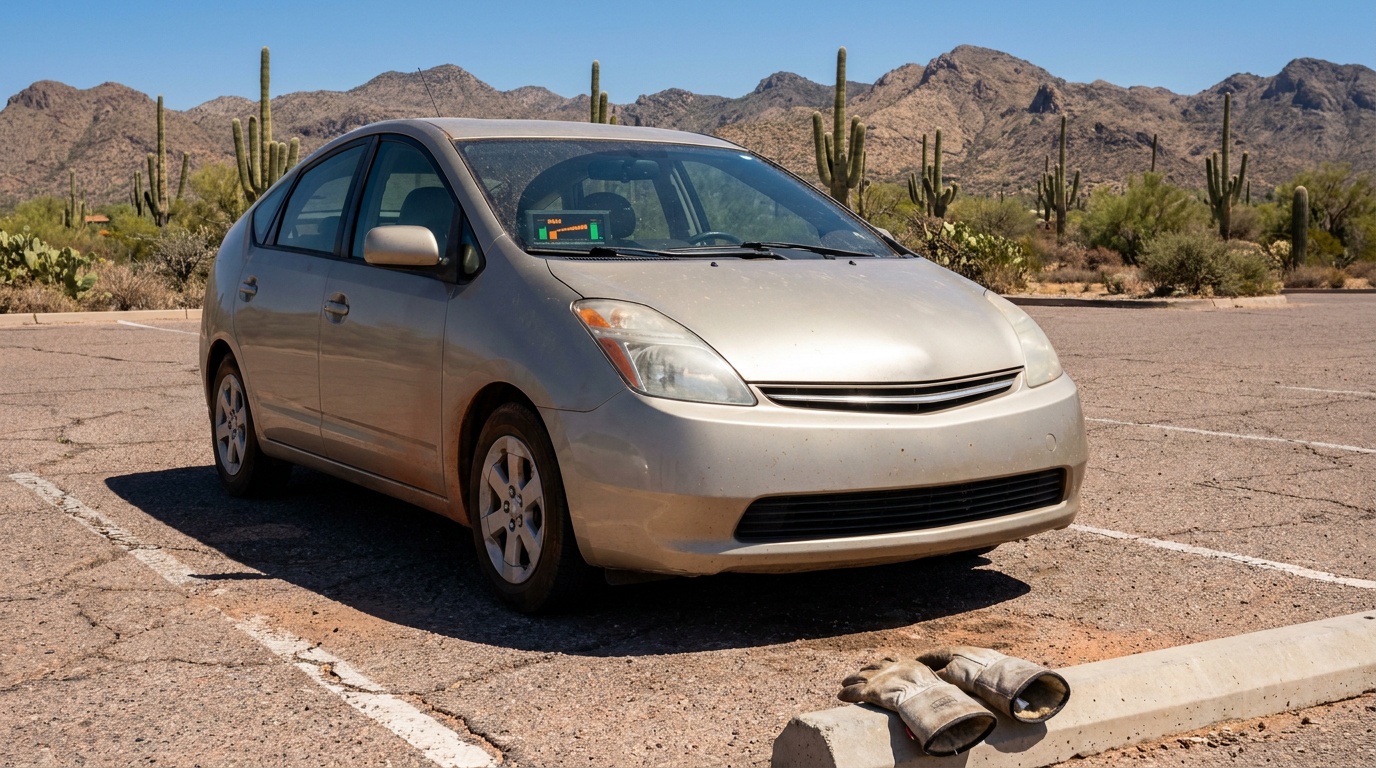
A Prius dropping from 48 to 32 MPG has lost a third of its economy. Here are the real causes in order of likelihood, and what the loss costs per month.
A drop from 48 MPG to 32 MPG is a 33% loss, and on a Prius with 130,000 miles or more in Arizona the most common single cause is a hybrid battery that can no longer hold enough charge to assist the engine. The second most common is a blocked battery cooling path — which is really the same problem one stage earlier.
The giveaway is the pattern. A weak pack doesn't drop your mileage 2 MPG one month and 2 the next; it falls off over a few thousand miles and then sits at the new number no matter how you drive.
What is 16 MPG actually costing me?
Most owners never run this sum. Do it once and the decision gets a lot clearer.
At 1,000 miles a month — a normal Phoenix-area commute — here is the fuel you burn at each figure:
| Your MPG | Gallons per 1,000 miles | Extra gallons vs. 48 MPG | |---|---|---| | 48 | 20.8 | — | | 42 | 23.8 | 3.0 | | 38 | 26.3 | 5.5 | | 32 | 31.3 | 10.5 | | 28 | 35.7 | 14.9 |
At 32 MPG you're buying roughly ten and a half extra gallons every month. Multiply that by whatever you paid at the pump last week and by twelve. For most drivers the answer lands somewhere in the hundreds of dollars a year — money that is leaving the account whether or not the dash has lit up.
That number matters because a weak pack usually gets ignored until a warning light forces the issue. The light is not the start of the cost. The fuel gauge was.
Why does a weak battery burn more gas?
The engine and the battery share the work. Under acceleration the pack is supposed to supply a chunk of the power; under braking it takes energy back. When cells degrade, the battery's usable window shrinks. The computer protects it by keeping the state of charge in a narrow band — it won't let it discharge deeply and it can't absorb a full regen event.
So the engine covers the gap. It runs at stoplights it used to shut off at, it stays on at 25 MPH where it used to glide, and the brake energy that used to go back into the pack goes out as heat instead. Nothing feels broken. You just stop seeing EV mode.
Watch the charge bar on the energy screen. A healthy pack moves through the middle of the range gradually. A tired one swings from two bars to full and back within a single mile, and often rests at purple or the bottom blue after a freeway run.
What else could it be?
Go down this list in order. Several of these stack — it's common to have a mildly weak pack and a clogged EGR on a third-generation car.
| Cause | Other symptoms with it | How it's confirmed | |---|---|---| | Weakening hybrid pack | Charge bar swings fast, engine rarely shuts off, less EV, weak acceleration, eventually P0A80 | Module-by-module voltage and internal resistance readings under load | | Blocked battery cooling intake | Fan audibly loud, pack temps high, mileage worse in summer than winter | Inspect the intake vent behind the rear seat; compare battery temperature sensors | | Low tyre pressure | Mileage falls a few MPG, ride feels heavy, TPMS may not trigger | Gauge them cold — Prius doors usually call for around 35 PSI | | Short trips / cold starts | Worst numbers on 2–5 mile drives, better on long ones | Compare a 30-mile freeway tank to a city tank | | A/C running at full load | Summer-only drop, recovers in November | Compare same route in April and July | | Clogged EGR / intake (2010–2015) | Rough idle, misfire codes, coolant loss, sometimes a head gasket | Intake and EGR inspection, misfire and coolant checks | | Dragging brake or bad alignment | One wheel hot after driving, pulling, uneven tyre wear | Road test and wheel-by-wheel inspection | | 12V battery failing | Slow to boot, odd unrelated warnings, dash flickers on start | Load test the 12V — see 12V vs. hybrid battery testing |
Does Arizona change the answer?
Yes, and more than any other factor on this page. NiMH packs age on two clocks: cycles and heat. Phoenix supplies the heat.
The Prius pack is air-cooled by cabin air drawn through a vent low on the passenger side behind the rear seat. In a state where the car sits in 110°F parking lots and the cabin hits 140°F, that vent is doing critical work — and it is exactly where dog hair, floor mat fibres, dust and fast-food wrappers end up. A partially blocked intake raises pack temperature, which accelerates cell degradation, which drops your mileage, which is the symptom you noticed.
This is why Arizona Prius owners routinely see meaningful capacity loss around 8–12 years while the same car in a coastal climate goes 15 years. It also means a clogged intake caught early is a much cheaper conversation than one caught after four modules have fallen out of balance. Annual hybrid battery service exists for exactly that reason.
How do I find out which one it is?
A generic code reader won't tell you. It reads stored fault codes, and a pack that has lost a third of its capacity often has no stored code at all — that's the entire problem with waiting for the light.
What answers the question is live data: each module's voltage under load, the spread between the strongest and weakest blocks, internal resistance, and pack temperature. A pack with a 0.3V spread between blocks is telling you something a fuel-economy readout never will. That's what the hybrid battery diagnostic measures, and it's free — we come to your driveway or your workplace parking lot.
If the readings show the pack is the culprit, our pricing is set for Prius and CT 200h and includes installation at our shop: $600 rebuilt Essential with 6 months warranty, up to $3,500 for a new OEM pack with 5 years. Mobile install at your location is a $250 add-on. Most installs take about 30 minutes. Third-generation owners can read the model-specific detail on the 2010–2015 Prius page.
If it isn't the pack, you'll know that too, and you'll stop spending money guessing.
Call 623-323-0737 or book the free diagnostic and we'll come read your pack where the car sits.