How Fast Does Better MPG Pay Back a Hybrid Battery Repair?
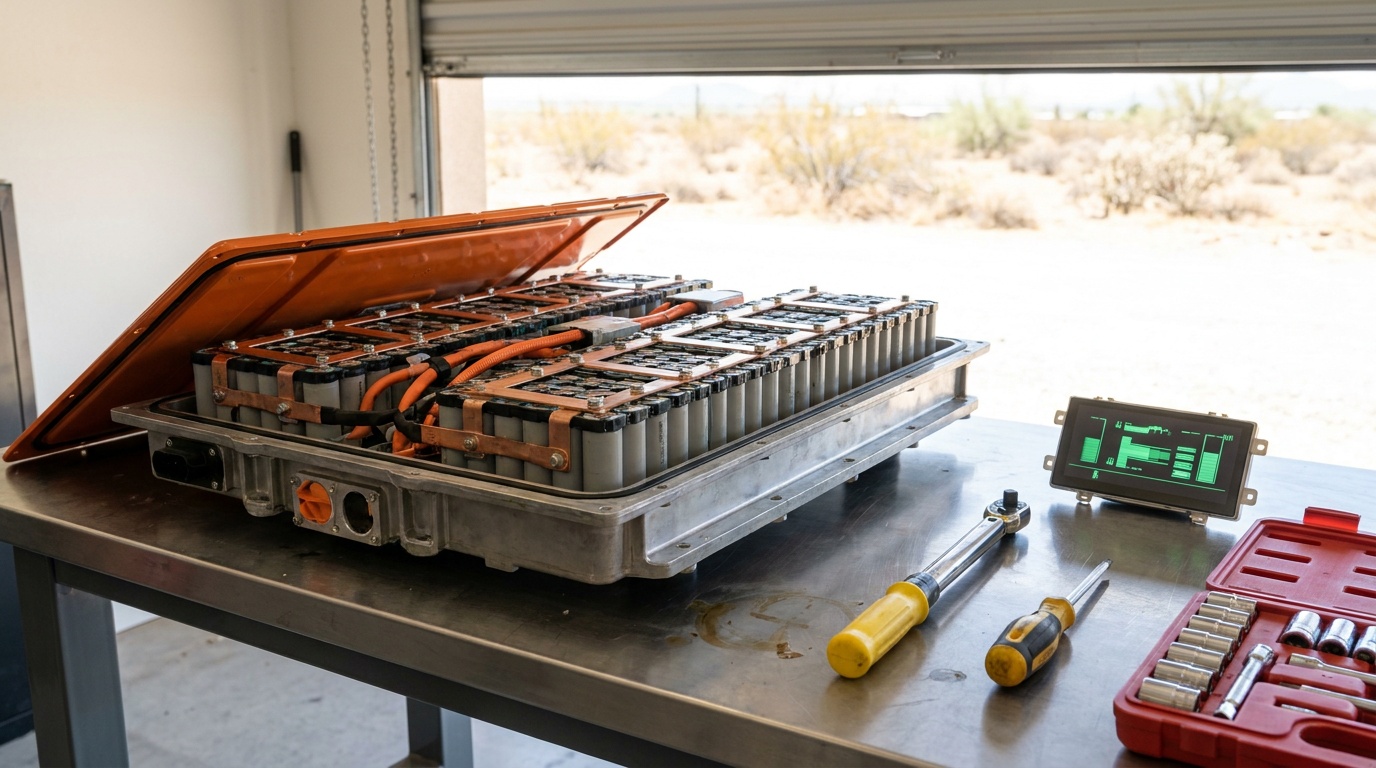
A Prius that slipped from 48 to 32 mpg burns about $42/month extra at 40 miles a day. Here's the real payback math on a rebuilt pack, by daily mileage.
At 40 miles a day, a Prius that has slipped from 48 mpg down to 32 mpg is burning roughly $42 a month in extra fuel — enough to pay back a $1,199 rebuilt Essential pack in about 28 months. Drive 80 miles a day and that same repair pays for itself in about 14 months.
That's the honest headline: fuel savings alone are real money, but they rarely repay a hybrid battery in a single year unless you drive a lot. The fuel math is the part most owners never calculate, though, and it changes the decision — because you are already paying for the worn pack, monthly, whether or not you fix it.
How do I calculate my own monthly fuel loss?
Three numbers: your current mpg, the mpg the car used to return, and your monthly miles.
The formula is gallons, not miles per gallon — mpg is deceptive because the same 10-mpg drop costs far more at the low end than the high end.
Monthly gallons wasted = (monthly miles ÷ current mpg) − (monthly miles ÷ original mpg)
Worked at 1,200 miles a month (40 miles a day), 48 mpg original, 32 mpg now, at about $3.40 a gallon:
- 1,200 ÷ 32 = 37.5 gallons
- 1,200 ÷ 48 = 25.0 gallons
- Difference: 12.5 gallons × $3.40 = $42.50 a month, or $510 a year
Adjust the pump price to whatever you actually paid this week — Arizona moves a good 40 cents a gallon between winter and the summer blend season, which swings the payback by several months on its own.
What does payback look like at my daily mileage?
Same 48 → 32 mpg drop, same $3.40 a gallon, 30 days a month. Find your row.
| Miles/day | Miles/month | Gallons wasted | Extra fuel cost | Payback: $1,199 Essential | Payback: $1,599 Extended | |---|---|---|---|---|---| | 20 | 600 | 6.3 | $21 | 56 months | 75 months | | 30 | 900 | 9.4 | $32 | 38 months | 50 months | | 40 | 1,200 | 12.5 | $43 | 28 months | 38 months | | 60 | 1,800 | 18.8 | $64 | 19 months | 25 months | | 80 | 2,400 | 25.0 | $85 | 14 months | 19 months | | 100 | 3,000 | 31.3 | $106 | 11 months | 15 months |
The Essential rebuilt pack is $1,199 installed with a 1-year warranty; Extended is $1,599 installed with a 4-year warranty. Both are set installed prices for Prius and CT 200h — other models vary on install labour. The full list, including new aftermarket and new OEM Toyota packs, is on the pricing page.
Read the table honestly. At 20 miles a day, fuel savings will not carry the repair — you fix the pack because the car needs to keep working, and the mpg is a bonus. At 60 miles a day and up, the pack effectively pays for itself well inside the warranty term on the Extended build.
Does a smaller mpg drop still matter?
Much less than people assume. Here's the same 40-mile-a-day driver at different levels of degradation:
| Economy now | Gallons wasted/month | Extra fuel/month | Extra fuel/year | |---|---|---|---| | 42 mpg | 3.6 | $12 | $145 | | 38 mpg | 6.6 | $22 | $268 | | 32 mpg | 12.5 | $43 | $510 | | 28 mpg | 17.9 | $61 | $729 | | 24 mpg | 25.0 | $85 | $1,020 |
A 48 → 42 slide is mostly tires, a roof rack, or short cold-start trips. A 48 → 30 slide with the engine idling at stoplights and the state-of-charge bar swinging from two bars to seven and back is a pack problem, and it usually shows up as P0A7F — hybrid battery pack deterioration before it ever escalates to P0A80.
Will I actually get all the mpg back?
Not always, and anyone who promises otherwise is guessing. The pack is one input. The rest of the car matters:
- EGR and intake carbon on 2010–2015 Prius. A clogged EGR circuit on a third-generation Prius costs real economy and a fresh pack won't fix it.
- Tire pressure and tire choice. A set of aggressive all-seasons at 30 psi instead of the door-sticker pressure can cost 3–5 mpg by itself.
- A blocked battery cooling fan. Phoenix dust and pet hair pack that intake solid. Cleaning it is a $99 installed upgrade and it protects the new pack more than it recovers mpg.
- Short trips. A hybrid that never reaches operating temperature burns fuel warming the catalyst, every trip, regardless of pack health.
Realistic expectation: a car that dropped from the high forties into the low thirties on pack degradation usually lands back in the low-to-mid forties, not perfectly at its original number. Build the payback math on that, not on the window sticker.
Why is the Arizona number different?
Two reasons, both pushing the same direction.
Heat is the largest factor in how NiMH packs age. A pack that lives in Phoenix, Mesa, or Surprise spends months of the year soaking at ambient temperatures that accelerate cell imbalance, so Arizona cars tend to reach the mpg-losing stage earlier in their mileage than the same car in a mild coastal climate. The degradation you're calculating around arrived sooner than the national averages predict.
Second, valley commutes are long. A Buckeye-to-Scottsdale run is 40 miles one way. Plenty of Arizona owners land on the 80- or 100-mile rows of that table, which is where the payback drops under a year and a half.
One caution on measuring: don't compare a July tank to a February tank. Air conditioning at 112°F loads the system hard and the engine runs more. Compare like months, or compare the same commute week over week.
What's the part fuel math doesn't capture?
A worn pack does more than cost you gas. It throws the red triangle master warning, it eventually strands the car, and it drags resale value on an otherwise sound vehicle. Fuel savings are the piece you can put a number on — usability is the piece you actually bought a hybrid for. And if your pack still has usable life, reconditioning or annual battery service can recover some capacity for far less than a replacement.
If you want this run with your own numbers, the payback calculator on our home page takes your mpg, your daily miles, and your pump price and does the same arithmetic in a few seconds.
Not sure whether your mpg loss is the pack or something else? Book a free mobile diagnostic — we come to you anywhere in the Phoenix metro, test the pack block by block, and tell you what the numbers actually say. Call 623-323-0737.